
Leadership isn’t shaped only by what happens around us. It’s also shaped by the meaning we give to what happens
A delayed response can become, “They don’t respect me.” A difficult conversation can become, “This isn’t going well.” A decision that doesn’t work can become, “I’ve got this wrong.”
The situation may be real, but the story we attach to it is an interpretation.
Those interpretations can influence how we respond, communicate, and make choices. Connected leadership begins with noticing the story before it starts directing our behaviour.
In this guide, you’ll explore how our internal lens influences leadership choices, what neuroscience tells us about these reactions, and a practical approach for creating greater clarity and trust.
The Lens Changes What We See
Imagine two people looking at the same ocean through different pairs of sunglasses.
One sees blue.
The other sees green.
The ocean hasn’t changed.
The lens has.
Leadership can work the same way.
Our experiences, beliefs, and past interactions influence the meaning we attach to what happens around us. A comment isn’t simply a comment. A delayed response isn’t simply a delayed response.
Our brain fills in the gaps.
This means two people can experience the same situation and interpret it very differently.
The important question isn’t always, “What happened?”
It’s also:
“What story am I telling myself about what happened?”
How Neuroscience Helps Explain Our Reactions
The brain constantly looks for patterns based on previous experiences and stored memories.
When something feels threatening, the limbic system can assign meaning before the prefrontal cortex, the part of the brain responsible for reasoning and perspective, has time to fully evaluate the situation.
This can cause us to react to our interpretation before we’ve considered whether that interpretation is accurate.
A delayed response might mean someone is dismissive.
Or they might be dealing with something you don’t know about.
A question might feel like criticism.
Or it might simply be an attempt to understand.
A decision might not produce the expected outcome.
That doesn’t necessarily mean the decision was wrong.
This is where a pause becomes valuable.
When we question our first interpretation, we create space to consider another perspective.
And that space creates choice.
Framing the Story
A practical way to work with these moments is through three simple steps.
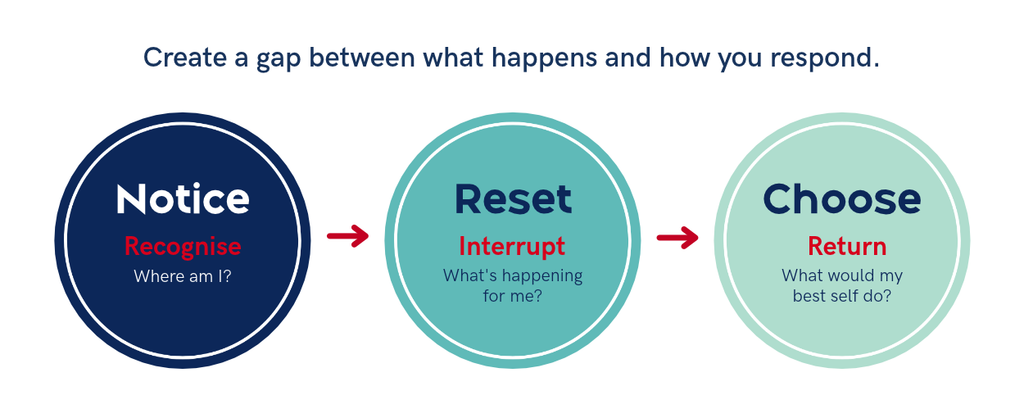
1. Notice
Start by identifying the story you’re telling yourself.
Put it into words.
Ask:
What story am I telling myself right now?
Naming the story creates awareness and clarity.
You can’t examine an interpretation you haven’t noticed.
2. Reset
Once you’ve identified the story, resist the immediate urge to treat it as fact.
Ask:
What else could be true?
What might I be missing?
Curiosity creates space between what happened and what you believe it means.
It allows you to consider another perspective and reset before deciding how to respond.
3. Choose
Once you’ve created that space, consider the response you want to make.
Ask:
What choice reflects the leader I want to be?
This is where awareness becomes leadership capability.
You may not be able to choose what happens.
You can choose how you respond to it.
Why This Matters for Connected Leadership
The stories we tell ourselves don’t stay inside our heads.
They influence our conversations.
They influence trust.
They influence how we interpret other people’s actions.
They influence the choices we make under pressure.
When leaders act on an unexamined interpretation, they may respond to something that isn’t actually happening.
When leaders pause, become curious, and consider another perspective, they create greater clarity and make more intentional choices.
That can change the quality of a conversation.
It can also change how people experience the leader.
Perspective Creates Choice
Connected leadership doesn’t require leaders to ignore their instincts or emotions.
It asks them to become more aware of what is happening internally before allowing that response to determine what happens next.
- Notice the story.
- Reset and be curious about what else could be true.
- Choose the response that creates the outcome you want.
These are small, practical choices.
But repeated consistently, they can strengthen trust, improve conversations, and build leadership capability.
Sometimes the situation doesn’t need to change.
The lens does.
“We see the world, not as it is, but as we are—or, as we are conditioned to see it.“
- Stephen R. Covey
Ready to Build Connected Leadership?
If you’re ready to strengthen trust, build greater leadership capability, and create better conversations across your organisation, Connected Leadership provides a practical, evidence-based approach grounded in neuroscience and positive psychology.
Book a discovery call with Justine Maree Cox to explore how Connected Leadership can help your leaders build clarity, make better choices, and strengthen performance through practical leadership strategies.