
Even the most capable leaders can find themselves staying quiet in important meetings, becoming defensive during feedback, or walking away from conversations wishing they had responded differently.
If you’ve ever questioned your confidence after one of these moments, you’re not alone and more importantly, it usually has nothing to do with your actual capability.
The truth is, your leadership capability isn’t the problem. Often, it’s your brain’s threat response limiting your access to it.
Understanding the neuroscience behind perceived threat gives leaders practical, evidence-based ways to strengthen leadership capability. In this article, you’ll discover why capable leaders sometimes lose access to clear thinking, why psychological safety builds stronger performance, and how Connected Leadership helps people make better choices when it matters most.
The Smoke Alarm Inside Every Leader
Think of your brain as a smoke alarm.
A smoke alarm doesn’t wait to confirm there’s a fire. It reacts the moment it detects smoke.
Your brain works in much the same way.
A difficult conversation.
Unexpected criticism.
Feeling excluded.
Having your ideas challenged.
To your brain, these situations register as immediate threats. They trigger a protective response long before you’ve had time to consciously process what’s happening.
When this occurs, your ability to think clearly and lead effectively is reduced as your brain shifts its focus from possibility to protection.
This is why psychological safety matters.
Psychological safety isn’t about avoiding difficult conversations or lowering expectations. It’s about creating an environment where people feel safe enough to think clearly, contribute honestly, challenge ideas respectfully, and have better conversations, even when the discussion is uncomfortable.
Connected Leadership begins by recognising when your internal smoke alarm has been activated.
Awareness creates choice.
Choice gives you better access to your leadership capability.
When Capability Isn’t the Problem
Earlier in my leadership career, I worked within a C-suite environment that gradually became increasingly unpredictable.
Over time, I noticed myself speaking less.
I second-guessed my ideas.
I overthought everything I wanted to contribute.
For a long time, I believed I’d simply lost confidence as a leader.
It wasn’t until I worked with my coach that I realised what was actually happening.
The environment had been activating my brain’s protection system.
Nothing was wrong with my capability.
I simply couldn’t consistently access it.
That awareness changed the way I lead.
Today, it sits at the heart of how I work with leaders to build trust, create clarity, and support better conversations that strengthen leadership capability and performance.
What Neuroscience Tells Us About Leadership Capability
Evidence-based research from David Rock, Joseph LeDoux, and Matthew Lieberman shows that social stressors, including criticism, uncertainty, exclusion, and perceived unfairness, activate many of the same brain systems involved in responding to physical danger.
In other words, your brain doesn’t dismiss these experiences as “just emotion.” They can set your smoke alarm off.
It responds as though something important needs protecting.
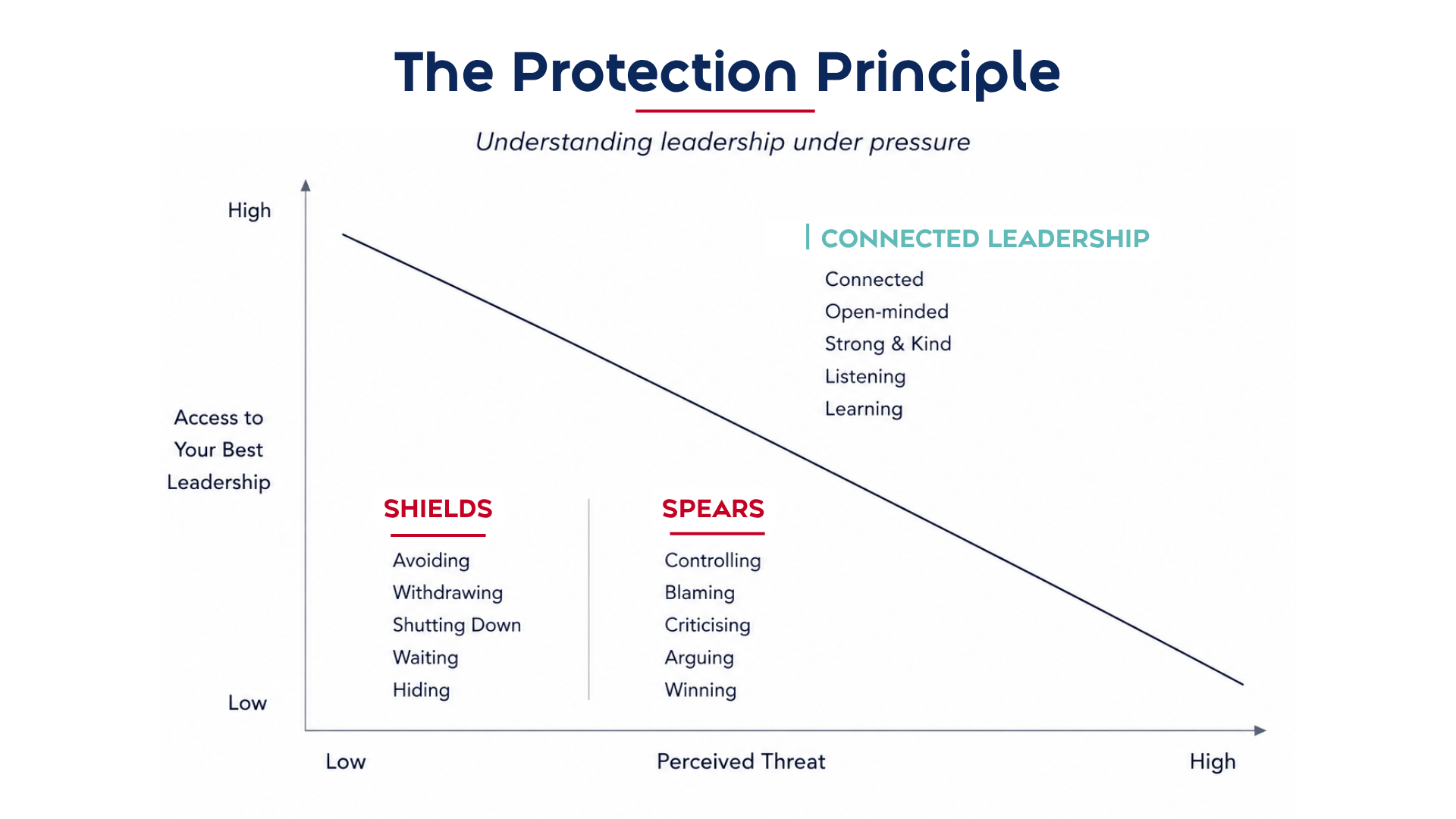
This is why neuroscience is such an important part of Connected Leadership.
When leaders reduce unnecessary social threats, people regain access to:
- Clearer thinking
- Better judgement
- Stronger decision-making
- Greater creativity
- Better conversations
- Improved performance
Trust isn’t simply a cultural value.
It’s one of the greatest sources of leadership leverage because it allows people to consistently access their strengths and capability.
“Between stimulus and response there is a space. In that space is our power to choose our response.”
— Viktor Frankl
A Practical Leadership Reflection
This week, notice your own smoke alarm.
Pay attention to the moments when you become defensive.
When you withdraw.
When you over-explain.
When you feel the need to control the conversation.
Rather than asking,
“What’s wrong with me?”
Ask instead,
“What is my brain trying to protect?”
That single question creates awareness.
Awareness creates choice.
Choice gives you greater access to your leadership capability.
Connected Leadership isn’t about never experiencing threat.
It’s about recognising it early enough to choose a response that builds trust, creates better conversations, strengthens performance, and leaves a positive impact on the people around you.
Ready to Build Leadership Capability Across Your Team?
If you’re ready to create a Connected Leadership culture built on trust, clarity, and practical, evidence-based leadership, let’s have a conversation.
Discover how neuroscience, positive psychology, and Connected Leadership can help your leaders strengthen their leadership capability, create better conversations, and improve performance across your organisation.
Book a discovery call to explore how Connected Leadership can create lasting impact for your people and your business.