
Connected leadership begins with self-awareness. The ability to notice your thoughts, emotions, and behaviours in the moment is one of the strongest predictors of trust, better decision-making, and sustainable performance. When leaders become more aware of their responses under pressure, they create better conversations, build stronger teams, and increase their leadership capability.
In this article, you’ll discover why self-awareness is essential for connected leadership, what neuroscience tells us about our reactions under pressure, and practical strategies you can apply immediately to make stronger leadership choices.
Why Self-Awareness Matters in Connected Leadership
One of the biggest reasons good leaders lose trust isn’t because they make poor decisions.
It’s because they don’t notice the impact they’re having while they’re making them.
Under pressure, we all become less aware of ourselves.
- We interrupt.
- We become defensive.
- We solve instead of listening.
- We focus on being right instead of being effective.
Connected leadership begins the moment we notice what’s happening within us and choose a different response.
That single moment of awareness creates a new choice, one that strengthens trust instead of weakening it.
Create Space to Choose
Imagine trying to lead a team while wearing a blindfold.
You would still make decisions.
You would still speak.
You would still influence people.
You just would not see your impact.
Self-awareness helps remove the blindfold. It brings your internal reactions and external impact into clearer view.
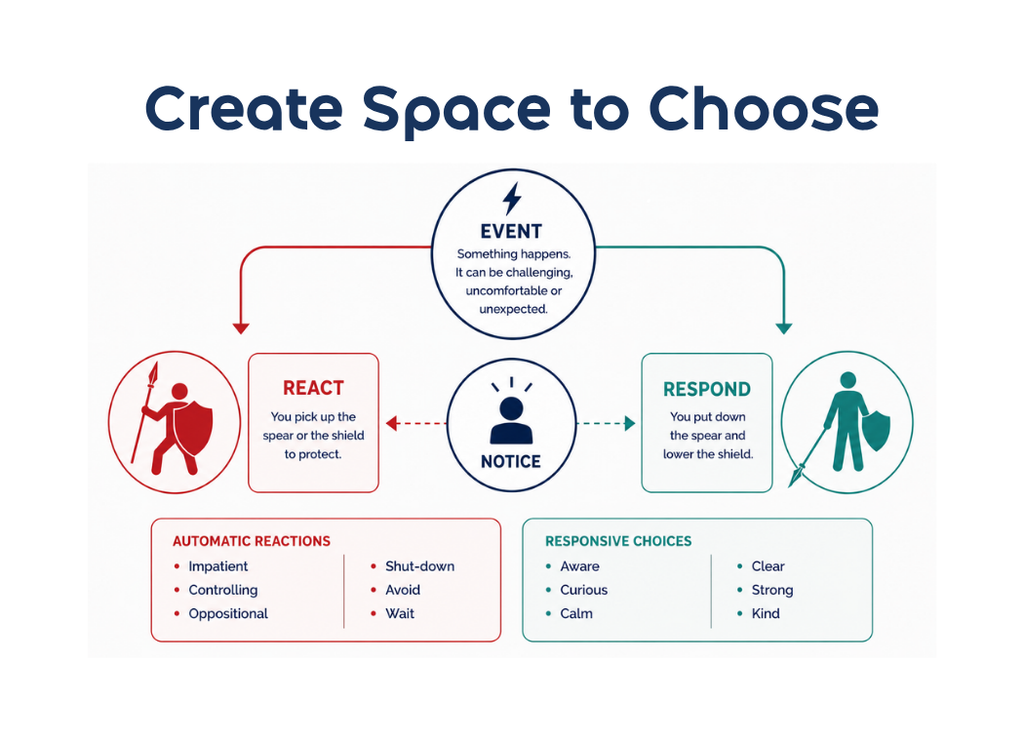
This is where Create Space to Choose begins.
Something happens. We notice what is taking place, including our thoughts, emotions, and automatic reactions.
We can react automatically, driven by emotion, habit, or reflex. Or we can pause, create space, and choose a more deliberate response.
That pause gives us the opportunity to put down the shield, lower our defences, and respond with greater awareness, clarity, and intention.
Every pause is a choice.
And every choice shapes how we communicate, build trust, and lead others over time.
Create Space to Choose is not about eliminating difficult reactions. It is about becoming more aware of them, and developing the capacity to choose how we respond.
Better Conversations Start With Trust
Psychological safety starts long before someone chooses to speak up.
It starts with how leaders respond.
When leaders stay calm, listen with curiosity, and regulate their emotions, people feel safe to contribute ideas, ask questions, and take ownership when mistakes happen.
Trust is not a milestone.It is a daily practice.
It’s built through consistent choices.
Those choices create better conversations, clearer thinking, and stronger performance across teams.
What Neuroscience Tells Us About Leadership Under Pressure
Neuroscience shows us that when pressure rises, the amygdala, the brain’s built-in threat detector, responds in milliseconds, preparing us to fight, flee, or protect ourselves.
The prefrontal cortex, the part of the brain responsible for reasoning, perspective, and sound judgement, becomes more active when we pause.
That pause creates space between stimulus and response.
It’s within that space that connected leaders choose intention over instinct.
Strong leaders do not experience less pressure.
They simply catch their reaction faster and respond with intent.
A Leadership Lesson I’ll Never Forget
Early in my leadership career, a team member missed something important.
My first instinct was to step in and take over.
Instead, I paused.
I noticed my frustration, took a moment to breathe, and chose curiosity.
Rather than making assumptions, I asked questions.
The conversation changed immediately.
They took ownership.
Together we found the solution.
Trust became stronger.
The issue wasn’t the mistake.
My reaction had the potential to become the problem.
That brief pause changed the outcome.
This is why leadership expert Dr. Daniel Goleman says:
“Self-awareness is the most important leadership skill we can develop. It is essential for knowing strengths and weaknesses, for extraordinary business acumen, and for high levels of emotional intelligence.”
— Dr. Daniel Goleman
A Practical Reflection to Build Leadership Capability
The next time you notice pressure building, pause before responding.
Ask yourself:
- What triggered my reaction?
- What am I noticing in my body?
- What has become harder to see with clarity?
- What could become possible if I paused for five seconds?
These questions are not about self-criticism.
They are about expanding what you notice.
Because every leadership challenge presents two choices.
React.
Or notice.
The leaders who build the greatest trust aren’t the ones who never feel pressure.
They’re the ones who notice it first.
Because you cannot change what you do not notice.
And you cannot lead what you do not see.
Ready to Build Connected Leadership?
If you’re ready to strengthen trust, build greater leadership capability, and create better conversations across your organisation. Connected Leadership offers the roadmap.
It delivers a practical approach backed by evidence, neuroscience, and positive psychology.
Whether you’re developing emerging leaders or strengthening an experienced leadership team, the right leadership choices create lasting impact for your people and your organisation.
Book a discovery call with Justine Maree Cox to explore how Connected Leadership can help your leaders build clarity, strengthen trust, and drive performance through practical, proven strategies.