

Effective leadership isn’t about choosing between being respected and being liked.
It’s about developing the capability to lead with both strength and kindness.
Some leaders care deeply about their people but hesitate when difficult conversations arise. Expectations become less clear, issues remain unresolved, and standards can gradually drift.
Others focus strongly on clarity and performance, but without enough kindness, people may stop speaking up. They follow instructions, but their ideas and concerns remain unspoken. Over time, trust can erode.
Connected leadership brings both together.
In this guide, you’ll explore why strong and kind leadership creates the conditions for trust, psychological safety, ownership, and performance, and how to bring both qualities into difficult conversations.
Strength and Kindness Are Two Wings of Leadership
I’ve come to think about leadership much like watching a bird in flight.
A bird cannot fly with one wing.
Strength is one wing.
Kindness is the other.
Too much of one without the other can send it off course.
Only when both work together does it create lift.
That’s why strong and kind is the standard.
People need psychological safety.
They also need clarity about what is expected.
Kindness creates safety. Strength creates clarity.
Together, they create trust.
When people trust their leaders, they are more likely to speak openly, contribute ideas, learn from mistakes, and take ownership.
What Happens When Leadership Tips Too Far in One Direction?
Consider a leader who genuinely wants people to feel valued.
- They listen.
- They support their people.
- They care about their experience.
But when a difficult conversation arises, they hesitate.
- They soften expectations.
- They avoid addressing an issue.
- They hope the problem will resolve itself.
Over time, clarity can disappear.
Now consider the opposite.
A leader sets high standards, makes decisions quickly, and expects strong performance. But if those expectations aren’t balanced with kindness, people may become cautious about speaking up.
They may comply without contributing.
The team may continue delivering results, but people can become less willing to share ideas, raise concerns, or challenge assumptions.
Neither approach creates the conditions for strong, sustainable performance.
The opportunity is to hold both.
This is the thinking behind the Strong & Kind Leadership Scale.
The lens looks at leadership through two dimensions: strength and kindness.
When we map these two qualities against each other, four distinct leadership patterns emerge.
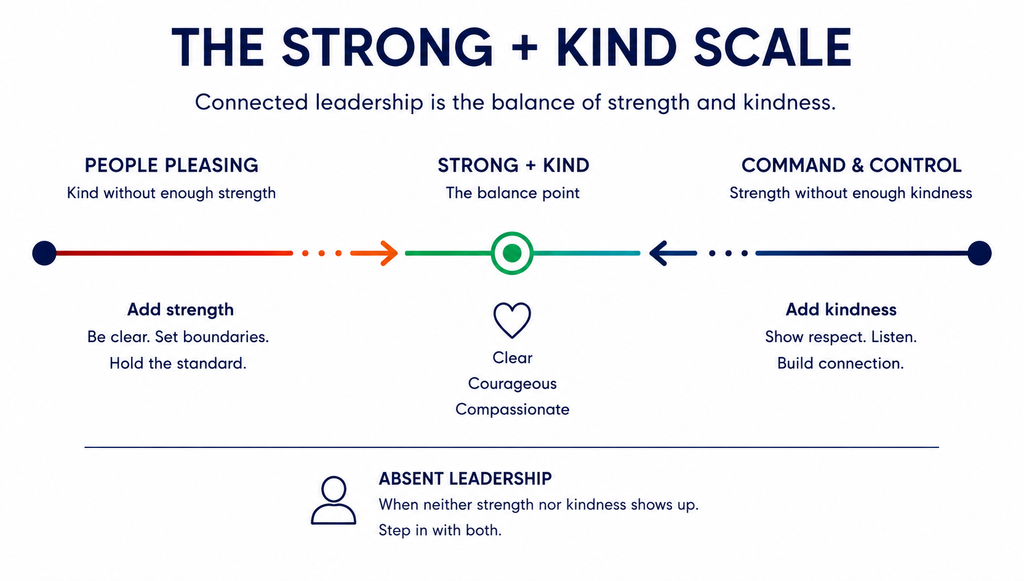
1. People Pleasing
High kindness, lower strength
These leaders genuinely care about their people and want them to feel supported. But when strength is missing, kindness can become avoidance.
Difficult conversations may be delayed. Expectations may become softer. Leaders may prioritise keeping people comfortable over addressing what needs to change.
The intention is positive, but the impact can be a lack of clarity and accountability.
2. Absent Leadership
Lower strength, lower kindness
When both strength and kindness are lacking, leaders may become disconnected from the people and the performance they are responsible for.
Issues can go unaddressed. People may be left without support, direction, or clear expectations.
This can create uncertainty and disengagement.
3. Command and Control
High strength, lower kindness
These leaders may be clear, decisive, and highly focused on standards and results.
But when strength isn’t balanced with kindness, leadership can become overly directive.
People may follow instructions without feeling safe enough to question, contribute, or raise concerns.
Performance may be achieved through pressure rather than trust.
4. Empowered Leadership
High strength, high kindness
This is where strength and kindness work together.
The leader maintains clear expectations while creating space for people to be heard.
They can address difficult behaviour without attacking someone’s character.
They can listen with empathy without avoiding accountability.
They can be clear without being harsh and kind without becoming unclear.
This is the balance that creates the conditions for trust, ownership, psychological safety, and sustainable performance.
The goal isn’t to become a leader who is simply stronger or simply kinder.
It’s to develop the capability to lead with both.
Why Psychological Safety and Clarity Matter
Psychological safety allows people to speak openly, learn from mistakes, and contribute ideas.
At the same time, people need clarity.
They need to understand what is expected, what needs to change, and what happens next.
These aren’t competing needs.
They work together.
A leader can acknowledge someone’s experience while still being clear about an issue.
A leader can listen with empathy while maintaining expectations.
A leader can challenge behaviour while protecting dignity.
This is where strong and kind leadership becomes practical.
Neuroscience Supports the Need for Both
The brain responds to uncertainty, perceived unfairness, and threats to social standing.
When people feel threatened, their thinking can become narrower and more defensive.
When people experience greater certainty, fairness, and respect, they are better positioned to think clearly and contribute.
This is one reason leadership behaviour matters so much.
The way a leader communicates can influence whether people become defensive or remain open to the conversation.
Kindness can create greater safety.
Clarity can create greater certainty.
Together, they create conditions for better conversations.
Five Practical Choices for Difficult Conversations
When you’re preparing for a challenging conversation, consider these five steps.
1. Regulate Yourself Before You Respond
Your emotional state influences the conversation.
Pause before responding so you can choose your words and approach with greater clarity.
2. Focus on the Issue, Not the Person
Address the behaviour, situation, or outcome that needs attention.
Don’t turn an issue into a judgement about someone’s character.
3. Lead With Curiosity and Respect
Ask questions.
Listen carefully.
Make space for the other person’s perspective.
Curiosity can create a better conversation without removing clarity.
4. State Expectations With Confidence
Kindness doesn’t mean leaving people uncertain.
Be clear about what needs to happen next and why it matters.
5. Follow Through Consistently
Trust develops through consistency.
When leaders follow through on what they communicate, people know what to expect.
That clarity strengthens trust and ownership.
Strong and Kind Is a Leadership Standard
Strong leadership isn’t loud.
Kind leadership isn’t weak.
The most effective leaders understand that strength and kindness are not opposing qualities.
They are two capabilities that work together.
Strength provides clarity. Kindness creates safety.
Together, they build trust.
And trust creates the conditions for people to contribute, take ownership, strengthen their capability, and perform at their best.
As Jacinda Ardern put it:
“You can be kind, but strong; empathetic, but decisive; optimistic, but focused.”
That’s more than a leadership style.
It’s a leadership standard.
A Question for Leaders
Think about a recent difficult conversation.
Did you choose kindness without enough clarity?
Or clarity without enough kindness?
What happened because of that choice?
The next time a difficult conversation arises, consider what might change if you didn’t have to choose between the two.
Lead with strength. Lead with kindness.
Ready to Build Connected Leadership?
If you’re ready to strengthen trust, build greater leadership capability, and create better conversations across your organisation, Connected Leadership provides a practical, evidence-based approach grounded in neuroscience and positive psychology.
Book a discovery call with Justine Maree Cox to explore how Connected Leadership can help your leaders build clarity, strengthen trust, and create lasting performance through practical leadership strategies.